|
TrioCFD 1.9.8
TrioCFD documentation
|

|
TrioCFD 1.9.8
TrioCFD documentation
|
The domain used for the different phases must be defined by a medium characterized by one or more fluid subdomains of different properties. This composite environment is defined by Milieu_composite. The models give the basic properties of fluids: kinematic viscosity \(\mu\), density \(\rho\), thermal diffusivity \(\alpha\), conductivity \(\lambda\), heat capacity \(Cp\) and thermal dilatation coefficient \(\beta_{co}\). The base class Fluide_reel_base (reading T_ref, P_ref) fills the property tables rho_, h_, cp_, beta_, mu_, lambda_ and their pressure/temperature derivatives.
Incompressible fluid (Fluide_Incompressible, from TRUST): gives the properties above (or 0), but the density is mandatory; neither the density nor the specific heat can be a Champ_Uniforme.
Sodium gas / liquid (Fluide_sodium_gaz, Fluide_sodium_liquide): read Lois_sodium.h, valid from the solidification temperature to the tri-critical point (371 K to 2503.7 K, pressure \(4.127\times10^{-6}\) to \(260\times10^5\) Pa).
Stiffened gas (Fluide_stiffened_gas, params gamma, pinf, mu, lambda, Cv, q, q_prim; \(Cv=R/(\gamma-1)\) by default):
\[\rho=\frac{p+\texttt{pinf}}{(\gamma-1)(T+273.15)\,Cv}, \quad h=\gamma\,Cv\,(T+273.15)+q, \quad cp=\gamma\,Cv, \quad \beta=\frac{1}{T+273.15} \]
with \(\partial_P\rho=\frac{1}{(\gamma-1)(T+273.15)Cv}\), \(\partial_T\rho=-\frac{p+\texttt{pinf}}{(\gamma-1)(T+273.15)^2 Cv}\), \(\partial_P h=0\), \(\partial_T h=cp\), \(\mu\) and \(\lambda\) constant.
R12_C1 and Eau_c3 (Fluide_R12_c1_*, Fluide_eau_c3_*): the low-boiling refrigerant R12 (dichlorodifluoromethane) mimics pressurized-water-reactor dimensionless numbers (values from the Cathare code). For example [98] :
| Property | Water | R12 |
|---|---|---|
| Pressure [bar] | 155 | 26 |
| \(T_{sat}\) [°C] | 344.9 | 86.5 |
| \(\rho_{liquid}\) [kg/m³] | 594.4 | 1019.3 |
| \(Cp_{liquid}\) [kJ/kg] | 8.950 | 1.413 |
| \(\lambda_{liquid}\) [W/m/K] | 0.472 | 0.0458 |
| \(\mu_{liquid}\) [Pa·s] | \(6.82\times10^{-5}\) | \(9.23\times10^{-5}\) |
| \(\rho_{steam}\) [kg/m³] | 101.9 | 170.7 |
| \(Cp_{steam}\) [kJ/kg] | 14.0 | 1.281 |
| \(\lambda_{steam}\) [W/m/K] | 0.126 | 0.0175 |
| \(\mu_{steam}\) [Pa·s] | \(2.30\times10^{-5}\) | \(1.57\times10^{-5}\) |
| \(\sigma\) [J/m²] | \(4.65\times10^{-3}\) | \(1.80\times10^{-3}\) |
| \(L_{vap}\) [kJ/kg] | 966.2 | 86.48 |
MUSIG fluid and medium (Fluide_MUSIG, Milieu_MUSIG): in the homogeneous MUlti-SIze Group (MUSIG) approach, a distribution of bubbles/droplets between \(r_{min}\) and \(r_{max}\) is characterized by a statistical law (linear LIN, exponential EXP or log LOG) discretized into \(n\) sub-groups with the same velocity [19].
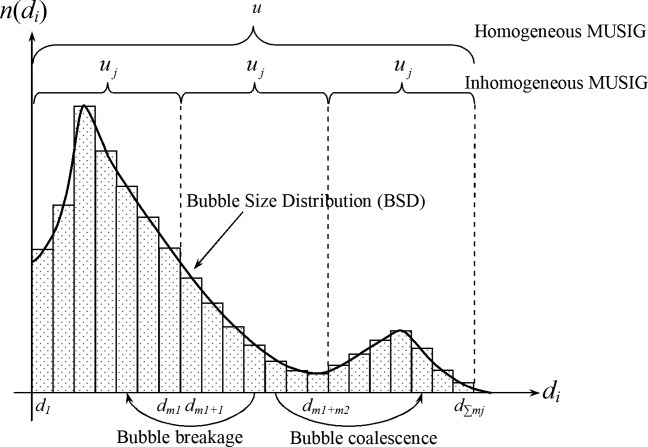
All bubbles from the sub-groups share the velocity of the mean Sauter diameter \(D_{sm}\) of the distribution, so a single common set of (mass, momentum, energy) equations is solved, with new source terms linked to changes in the distribution (dilatability, coalescence, break-up). Example dataset:
The liquid-gas interface is characterized by the surface tension \(\sigma\) (Interface_base, which fills sigma_). The simplest model is a constant surface tension (Interface_sigma_constant).
The saturation models give the thermal properties at saturation conditions (Saturation_base, inheriting from Interface); they fill Tsat, Psat, Lvap, Hls (liquid enthalpy at saturation), Hvs (steam enthalpy at saturation) and their pressure/temperature derivatives. A unique pressure field is assumed.
Constant saturation properties (Saturation_constant, params Tsat, Psat, Lvap, Hlsat, Hvsat, tension_superficielle): exactly two of {Lvap, Hlsat, Hvsat} must be given (the third is deduced, \(H_{vs}=H_{ls}+L_{vap}\)); all derivatives with respect to pressure/temperature are zero. Sodium saturation properties are given by Saturation_sodium.
Fluid properties can be managed through an external software: EOS (the CEA-EDF software for state-equation management, which can use a user-defined equation through a plugin) or CoolProp (an open-source alternative). Both can call the NIST state-equation software Refprop. The generic TPPI tables are implemented in Fluide_generique_TPPI_base (validity domain tmin_, tmax_, pmin_, pmax_).
CoolProp (Fluide_generique_CoolProp, params model, fluid): provides free state equations for a selected list of fluids.
EOS (Fluide_generique_EOS, params model, fluid, optional phase): Refprop offers 147 pure fluids, 5 pseudo-pure fluids (such as air) and mixtures with up to 20 components. For example, a boiling flow using refprop10:
The corresponding saturation properties use Saturation_generique_TPPI_base (CoolProp/EOS), e.g. saturation_eau saturation_generique_EOS { model refprop10 fluid waterliquid }. A sigma_mano parameter is available to input the surface tension manually when the TTSE surface-tension call in CoolProp fails.
 1.16.1