|
TrioCFD 1.9.8
TrioCFD documentation
|

|
TrioCFD 1.9.8
TrioCFD documentation
|
The goal here is to set up a stationary test case. By stationary, we mean that only the stabilized result (i.e. at the end of the transient) is worthy of interest and analysis. In this type of test case, only the final stationary results are correct. The results obtained during the transient period that leads to the final stationary state are not necessarily correct and must not be analyzed.
Take the example of a square cavity with a moving top wall (an imposed velocity on the top wall, in single-phase flow). The motion of the top wall creates a main vortex at the center of the cavity, with recirculations at the two lower corners.
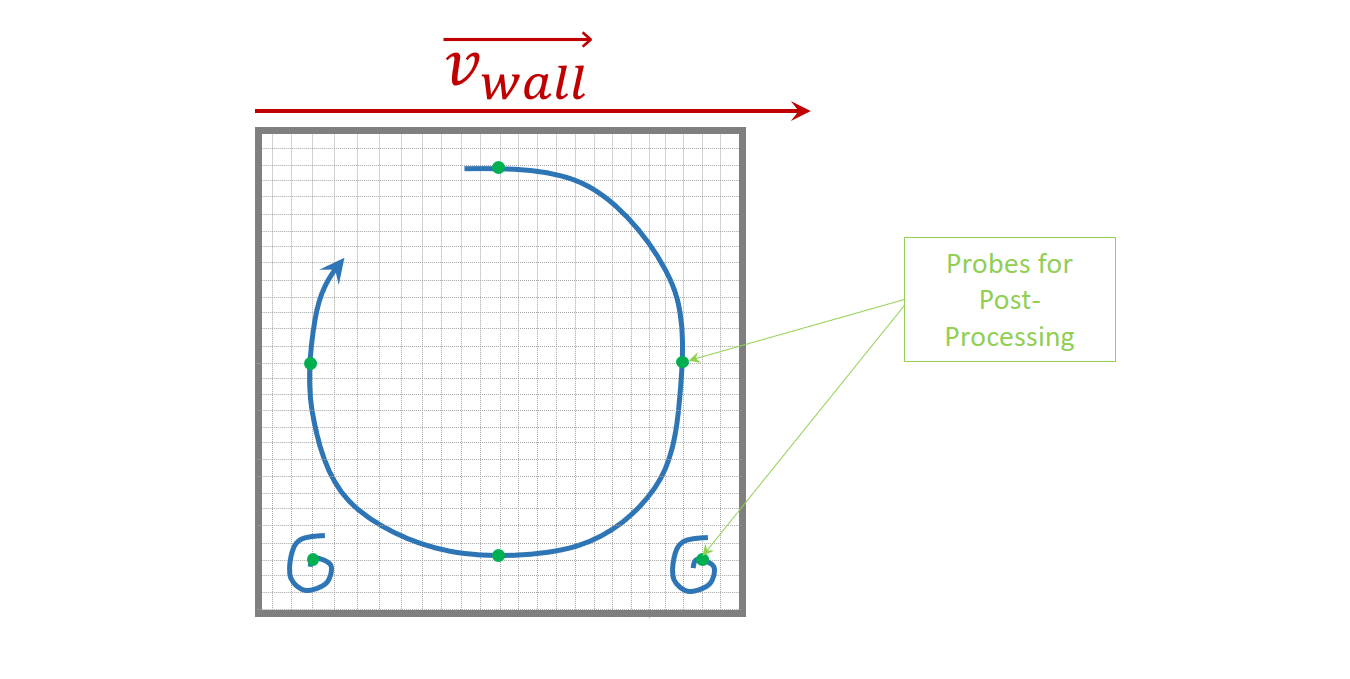
The steps to define this type of computation are as follows:
A first version of the dataset is then assembled and the computation can be launched over 3 seconds, thus providing 3 lata outputs for the various fields defined. It is important to make sure that everything works correctly by first verifying that this preliminary computation finishes properly.
If the preliminary computation does not run, the first reflex is to look at the error message in the .err. If, at this stage, the computation has not succeeded, it is very likely that there is a convergence problem. We then look at the values of the stability time steps, both for convection and diffusion, in the .out output file. If the values of the stability time steps are very small (< dt_min), it is then necessary to decrease the value of dt_min until the computation runs.
If the preliminary computation finishes successfully, we then look at the stability time steps for convection and diffusion in the .out output file in order to adapt the dt of the post-processing (lata) files accordingly. We will rerun the computation over 1000 time steps, having taken care to increase the probe saving frequency to every 100 time steps (versus every second during the preliminary computation). With this new time-step definition, we will obtain 10 probe results (lata) already giving a good impression of the progress of the computation.
If the physical phenomena are still developing, that is, the velocity of each probe has not reached stability, we then increase the computation time (tmax), taking care to adapt the lata frequency accordingly, and we restart the computation. We repeat this step while monitoring the development of the flow through the probes and the lata outputs. We will repeat this step as many times as necessary until the stationary state of the problem is obtained. This stationary state is reached when the evolution of the velocity on all probes becomes constant. By observing the time steps in the .out output file, we notice that TrioCFD progressively increases the time steps because it knows — from the time scheme defined — that the solution sought is a stationary solution, and therefore goes faster and faster to reach this state.
In order to make sure that this stationary state has been reached, it is recommended to look at the residuals. These (accessible in the .out output file) must decrease for the pressure and the velocity.
Typically, in the case considered here, particular attention should be paid to the cell in the upper-right corner of the domain, because it is the meeting point between a fixed wall and the moving top wall. It is then appropriate to determine where these residuals come from and how they stabilize. In this example, they will therefore be purely numerical and will not necessarily mean that there is a physical problem.
 1.16.1